


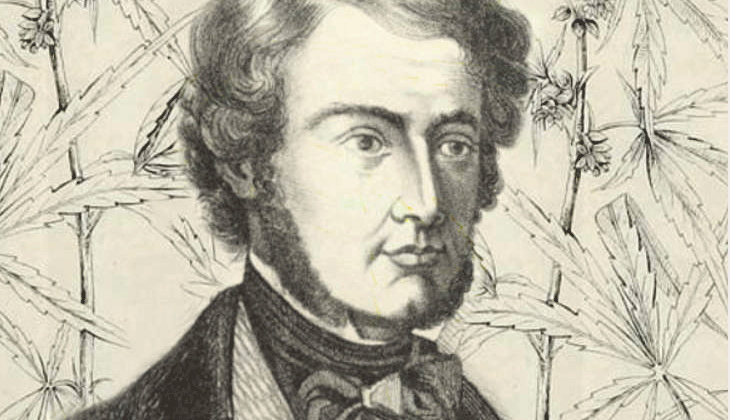
When weed comes up, the faces that pop into our heads are the famous ones: Bob Marley, Peter Tosh. Today we want to tell you about someone nobody has heard of who has done more for weed than plenty of cannabis activists.
William Brooke O'Shaughnessy: the grandad of cannabis research
William Brooke O'Shaughnessy was an Irish doctor born in the small town of Limerick in 1809, and it is thanks to this old boy that the medical potential of cannabis got written down for the first time from a scientific point of view. He studied medicine at Trinity College Dublin and later moved to London, where he ran into trouble finding steady work.

In 1833, at the age of 24, he took a job in Calcutta as an assistant surgeon with the prestigious British East India Company. The Irishman spent eight years in Calcutta working as a doctor and experimenting with all sorts of plants, opium and cannabis among them. That was when he noticed that cannabis was being used for medicinal and recreational purposes in the region, and he got straight down to studying it.

He realised that the Western medical literature of the day had no information at all on the use of that plant, so he pointed his whole research effort over the following years at studying it. He started his experiments on different animals: rats, rabbits, cats, dogs, horses. In those studies he described in detail how the hallucinogenic effect of the drug showed up in different ways depending on the animal. Once his own studies convinced him that cannabis use was safe, he moved on to experimenting with human beings, children and adults.

He worked with patients suffering from cholera, rheumatism, rabies, tetanus and convulsions and, although he found no sign that it cured the illness itself, he did write down what he considered the plant's usefulness against the symptoms. In 1839, when he presented a paper to the Medical and Physical Society of Calcutta in front of a room of students and academics, it went down very well in colonial England, and its medical use started spreading across Europe and the United States. After running into problems getting consistent results from different batches of plants, its use faded away over the years that followed.

From the 1930s onwards it started getting banned. In 1937 its sale was prohibited in the United States, in 1942 it was pulled from the pharmacological encyclopaedia and from the 1950s onwards people started getting fined for possession. The rest of the story we all know.
After the success of his paper on the medical potential of weed, O'Shaughnessy's interests changed and he moved on to electrical engineering. He died in 1889 in England, well off the public radar.
The way we see it, every time we smoke a joint we should be saying thanks to O'Shaughnessy for the mark he left on the world of weed. Would you fancy having him as your grandad? We would absolutely be into it.
More from The Smoker's Guide: Legalisation Failing in Canada? The Country Has a Surplus of 1.1 Billion Grams of Unsold Weed and What's the Difference Between Being High, Stoned or Baked?
