


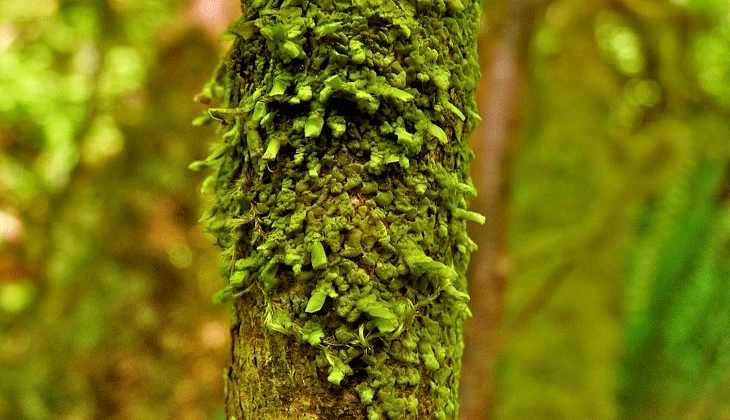
Earlier this week I left you an article about plants you can smoke that are not weed. Since I had already got stuck into the botanical side of things, I fancied carrying on writing about the subject.
Digging around a bit after a link from that earlier article, I started finding information about Radula and its psychoactive compounds, so I got down to work.
More on Radula: is it the weed of the future?
This plant is native to countries like New Zealand and Costa Rica, and the compounds found in it behave in the lab in a way that researchers describe as similar to cannabis. Radula belongs to the Radulaceae family, of which around 300 species are known, and psychoactive compounds have been confirmed in some of them.
A group of scientists from the universities of Bern and Zurich analysed the effects of perrottetinene in animals, one of the hallucinogenic substances in this genus. Although it does not belong to the cannabis genus as such, it is considered a moderately potent cannabinoid. Radula contains a variant of THC, but until then no study had been carried out to demonstrate it.
That team managed to define the toxicological consequences of the substance, mapping its effects one by one across 44 points in the central nervous system.

The conclusion they reached was that, just as happens with weed, the THC in this plant can build up in the brain. In those laboratory animals the team recorded analgesic effects and reported that it could cause catalepsy and hypothermia. The main difference they described is that Radula produced fewer adverse effects in the test animals, on memory for example.
"It is less potent and we can expect fewer effects on the central nervous system and, for example, on memory, but more studies are still needed to confirm it", says one of the Swiss scientists.
"So far, the species of Radula that contain this variant of THC are legal all over the world", the biochemist states.
Although, as the scientists put it, "the plant itself grows very slowly and produces only small amounts of the compound", it is not very clear whether it will be possible to synthesise it industrially on a large scale.

The bad part for those of us who like getting high is that, going by that lab work, the recreational effects come out weaker than what cannabis gives you. The good part is that Radula is the sort of thing researchers want to keep looking into, and that it is legal, so we will not be getting ourselves into trouble.
We reckon Radula is a bit of a dud and nothing touches weed, but we like keeping an open mind about new worlds. What do you lot think? Would you smoke Radula or would you rather stick with the usual? Leave us your thoughts.
You might also like Legalisation Failing in Canada? The Country Has a Surplus of 1.1 Billion Grams of Unsold Weed and What's the Difference Between Being High, Stoned or Baked?
