


Today at High As we are bringing you one of those stories about weed that deserve to be told.
We have covered so many topics on the blog by now that we wanted to start trying something different. We thought about interviewing interesting people who could give us their take on weed and on life, and today the first one has arrived.
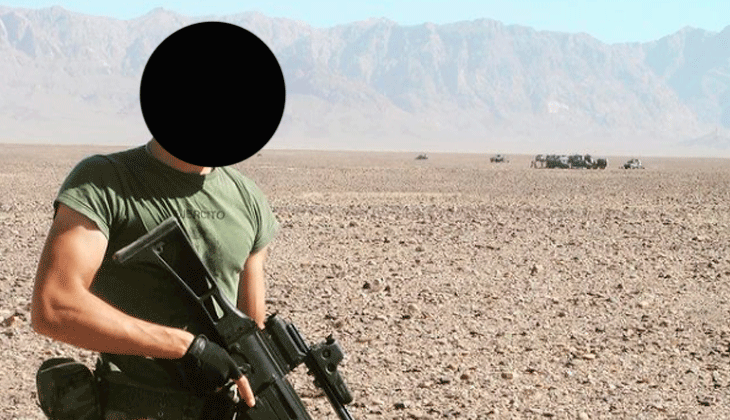
We interview a former special forces soldier who turns to weed to cope with post-traumatic stress
Right after we wrapped up that meeting and decided we had to tell one of a kind stories, Toni turned up in my life, as if saying it out loud had pulled him in. First of all, on my behalf and on behalf of the whole High As team, we would like to thank Toni for agreeing to the interview and for letting us tell his story.
1. Tell us who Toni is. What is your story?
Toni is a fussy guy, curious, proud, ambitious and sometimes obsessive, born in a small town in Alicante and with a clear calling from a very young age: to serve in the Armed Forces and become a Green Beret.
This kid did not stand out at anything: he was a bad student, he was no good at any sport and he was not popular, but he was not a "loser" either. What I do know is that this kid did not take kindly to injustice, and he did not like anybody treating another person badly.
A kid who developed a huge sense of justice early on, and who needed to test himself and find out whether he would have the guts to become the person he wanted to be. As soon as he turned 18 he enlisted in the Spanish Army and his first posting was the Mountain Infantry Brigade in the Pyrenees. That is where everything that made him the person he is now began.

2. A former special forces soldier who now designs video games. When and why did you decide to change career?
If being a soldier was number one on my list of goals in life, video games are without a doubt number two. Ever since I was little I loved playing them and I was constantly asking myself where all those polygons came from, or how it could be that pressing a button made the character jump or shoot. My curiosity needed feeding.
After 8 years of service, having been deployed in Kosovo, Lebanon and Afghanistan, and with my body wrecked by the demands of the units I served in, I decided to take on a new adventure and try to earn more money to fund all those projects that were keeping me awake at night.
Thanks to my CV I got into a Maritime Protection service as a team leader, deployed in the Indian Ocean to provide security for vessels that could be hijacked by pirates coming out of Somalia. Each deployment lasted 4 months, and between one voyage and the next I was called in to give weapons training to the new intakes. After 3 voyages, a lot of exhaustion and a considerable amount of money in the bank, I decided to go for it, study video game programming and tick off another of my dreams.
3. You were in the war in Afghanistan and also in Somali waters. Have you killed anyone on any of those missions?
That is the question people ask most often when they hear my story, and I do not blame them; I understand the curiosity. The truth is yes, I have killed. It is not something to be proud of, but I do not regret it: I did what I had to do. In the end, whatever the reasons that take you to a war, what is left is the will to live.
4. How did you feel when you pulled the trigger?
I have no confirmed kills in Afghanistan, because every engagement happened at distances where it was impossible to know whether you were the one who had hit a target. The first time I could confirm that I had taken out a threat was during my second voyage, when I had to sink a skiff full of pirates who were coming in dead set on hijacking the ship, opening fire with their AKs.
I was asleep; it was the watch of one of my guys and he raised the alarm. I got up without a second's delay, put on my vest, rifle in one hand and helmet in the other, and ran to my assigned post. I did not even put the helmet on: I left it to one side next to the rifle, mounted the machine gun at my post and without hesitating for a second I fired on the target and sank them.

5. Did you lose any comrades?
Yes, several. Some in the helicopters that were shot down in Afghanistan, others to IEDs (improvised explosive devices) and some in accidents in the operations area. It is something you can never shake off.
6. What were the years after that like?
I live a completely different life now, sitting in an air conditioned office, but my hands never forget the rifle. Those years shaped who I am now beyond any going back and they taught me things that would have been impossible to learn any other way.
7. You are here today because your story has to do with weed. Tell us a bit more.
From a very young age I had problems with tics, which a doctor would later diagnose as motor Tourette's. I was constantly cracking my neck and my back trying to settle an absurd urge that I have now learned to live with. I also have OCD, which is closely tied to the tics. I never knew what it was like to sit on a sofa and be relaxed reading a book.
In my last years of service, and being as rigid as you would expect from a soldier, I hated drugs. One day, at the house of a friend who smoked, talking about my problem with Tourette's, he offered me a few drags. At first I said no, but in the end desperation made me swallow my pride. I remember that feeling of peace, like something I had never felt before. I could sit there quietly without ticcing, which for me felt almost like a miracle. I even remember crying.
From that moment on my perception of drugs changed completely. Through reading I came across stories like mine and I started getting interested in meditation and alternative practices. In my own experience, THC not only left me feeling more relaxed, it also helped me get to know myself better.

8. In your view, can weed, used well, be a useful tool for people living with different symptoms?
Without a doubt, and always without overdoing it, weed is an incredible tool that Western medicine is missing out on because of prejudices that luckily are already starting to fade. I think trauma doctors could look into it for pain, neurologists for cases like mine and psychologists to help a patient face their own demons. That is my personal view, and it is something professionals would have to study and decide.
9. How is the video game world? Have you had to design anything war related?
Not professionally, only the odd demo on my own. The companies I have worked at do not develop that kind of game.
10. Which type of strain do you like best, indica or sativa?
Indica is the one I get on with best day to day, but for meditating, getting inspired or having a good time with friends I prefer sativa.
11. What do you think about legalising weed? Would it work in Spain?
After my experience I have no choice but to be in favour of legalising it. I would not dare say for sure whether it would work or not, because people are unpredictable and new challenges would definitely come up, but I think that with the right approach it could be done. What you need is a legal framework that makes sure people use it responsibly.

12. And as a last question, what do you think of other spiritual plants like Ayahuasca?
If we are talking about weed and the way people relate to it, we cannot skip over Ayahuasca. There were a few years when I was sunk in a depression, for longer than I care to admit. Just like with weed, I had to hit rock bottom before turning to things that, even with a more open mind, still raised doubts for me.
When you take "the medicine", as they like to call it, you get to a state where the wall of the ego disappears completely. It drags you through the thoughts you always avoid and forces you to face them so that, in the end, you let go of that trauma, with your body throwing it up. Thanks to that retreat I understood, among other things, that even though my job that day was to kill those pirates, I had to see them as people and understand their situation. I do not regret what I did, but I look at it now from a place that moves away from pride and turns into compassion.
Toni's story teaches us a lot about the more spiritual side of life and makes us think about the stigma that still surrounds weed and its legalisation. And, of course, it shows how much a person's relationship with the plant can change when you hear the story told first hand.
Thanks again to Toni for opening up to me while we were blowing smoke, and to High As for giving me the chance to tell stories like this one.
